Oliebollen: Dutch New Year's doughnuts
TL;DR
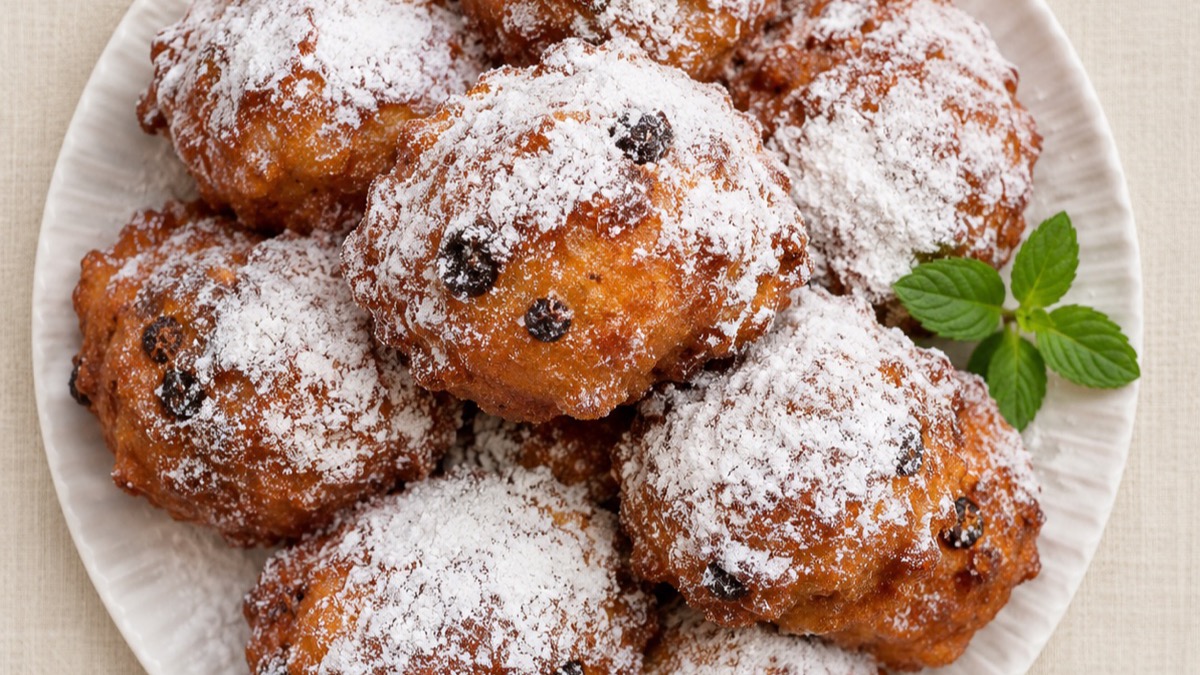
Oliebollen are balls of yeast dough fried in oil, with or without currants and raisins, and buried in powdered sugar. The Dutch eat them on New Year’s Eve. Stalls called oliebollenkramen pop up on squares and supermarket car parks from about early October and close in early January. Expect to pay about 1.25 to 1.50 euro each, and eat them warm.
| Question | Answer |
|---|---|
| What | Deep-fried yeast dough balls, plain or with currants and raisins |
| When | New Year’s Eve; stalls open from early October to early January |
| Where | Street stalls, bakeries, supermarkets, funfairs all year |
| Price at a stall (2025) | About 1.25 to 1.50 euro each; filled ones 2.50 to 3.50 euro |
| How to eat | Warm, by hand, with a thick layer of powdered sugar |
What are oliebollen?
An oliebol (plural oliebollen, literally “oil ball”) is a round piece of yeast dough fried in hot oil until it puffs up with a crisp outside and a soft, bready inside. The classic version has krenten en rozijnen, currants and raisins, mixed into the dough. The plain version is called naturel. Some stalls sell filled versions with apple, candied peel or cream.
An oliebol has no hole and no glaze, which is what sets it apart from an American doughnut. The only topping is poedersuiker, powdered sugar, sifted over the top from a shaker at the stall or at home.
When do the Dutch eat oliebollen?
On oudejaarsavond, New Year’s Eve, when almost every Dutch household has a bag of oliebollen on the table before the fireworks start. The stalls that sell them open from about early October and stay until early January, so the season builds for weeks and peaks on 31 December, when queues form at every stall. Outside that season you find oliebollen at funfairs in the Netherlands and Belgium all year.
Oliebollen sit on the Dutch food calendar next to the other winter treats, from Sinterklaas sweets in November to game on restaurant menus.
Where do oliebollen come from?
For centuries they were called oliekoeken, oil cakes. The word appears in Dutch as early as a Bible printed in 1528, and a Dutch recipe from 1668 fries a yeast dough of wheat flour, raisins, apple, almonds and spices in rapeseed oil. A painting by Aelbert Cuyp from around 1652 shows oliekoeken that look much like today’s oliebol. The name oliebol entered the Van Dale dictionary in 1868 and replaced oliekoek in the early twentieth century, according to the Dutch encyclopedia entry on the oliebol.
Nobody knows the exact origin. Some historians trace them to medieval winter baking in the Low Countries, others to Sephardic Jewish refugees who brought fried dough to the Netherlands.
How much do oliebollen cost?
At a stall in December 2025 a plain or currant oliebol cost about 1.25 to 1.50 euro. The stall voted best in Noord-Holland that year charged 1.30 euro for an oliebol of 96 grams. Filled oliebollen cost 2.50 to 3.50 euro. Stalls sell them by the piece and in bags of 5, 10 or more, and the bag price is cheaper per piece.
How to eat an oliebol
- Buy them warm and eat the first one on the spot.
- Hold the paper bag closed and shake it so the powdered sugar covers every side.
- Lean forward when you bite. The sugar goes everywhere, so skip the black coat.
- Warm leftovers for a few minutes in the oven. A microwave turns them tough.
Which stall makes the best oliebollen?
For years the Dutch answer came from the newspaper AD, which ran a national oliebollen test from 1993 to 2017. The paper stopped in 2018, together with its herring and fries tests, after arguments about how fair the scoring was, as NH Nieuws reported at the time. Since then a group of volunteers and experts has run an online test with a winner in every province.
Every town has its own favourite stall, and locals queue for it on 31 December. Ask the person next to you in the queue for theirs.
What else is on the stall?
Most oliebollen stalls also fry appelflappen, apple turnovers in puff pastry, and appelbeignets, apple rings in batter. Both get the same powdered sugar treatment. The words for all of them are in the Dutch menu decoder.
Questions people ask
When do Dutch people eat oliebollen?
On New Year's Eve, 31 December. The stalls that sell them open from about early October and close in early January, and funfairs sell them all year.
What is the difference between an oliebol and a doughnut?
An oliebol is a ball of yeast dough fried in oil, with or without currants and raisins, and dusted with powdered sugar. It has no hole and no glaze.
How much does an oliebol cost?
About 1.25 to 1.50 euro each at a stall in 2025, and 2.50 to 3.50 euro for a filled one.
Is there still an AD oliebollentest?
No. The newspaper AD ran its famous test from 1993 to 2017 and stopped in 2018. Volunteers have run an online test with a winner per province since then.